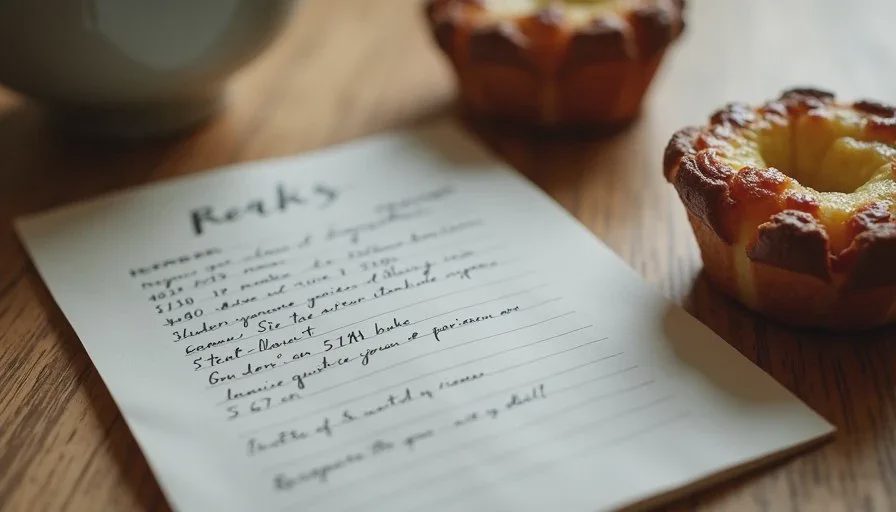
A recipe card that contains only the original ingredients and method is incomplete. The useful version also carries a few lines about what actually happened when the recipe was made: how the dough felt, how the cake rose, whether the timing matched the oven, and what small change improved the result. Those notes turn a single bake into information that can be used again. Without them, each attempt starts closer to zero.
I learned this the long way. For years I relied on memory and on the assumption that a well-written recipe would behave the same way every time. It does not. Flour varies, ovens run differently, room temperature shifts, and small handling differences accumulate. When I finally began writing short, concrete observations on the cards themselves, the number of repeated disappointments dropped. The notes did not need to be elaborate. They needed to be specific enough to remind me of the actual conditions and the actual outcome.
The suggestions that follow are the categories of notes I now consider worth the few seconds they take to write. They are drawn from the problems that appeared most often in my own kitchen and from the details that proved most useful when I returned to a recipe weeks or months later.
Why Memory Is Not Enough
Baking is full of variables that do not appear in the printed instructions. The flour may have been more or less absorbent than the last bag. The butter may have been colder or softer. The oven may have been running hotter that day. The dough may have needed an extra fold or a few more minutes of mixing. These differences are easy to notice in the moment and easy to forget later.
When the same recipe is made again without notes, the baker often repeats the same small errors or fails to repeat the small successes. A cake that was slightly dry is made the same way and turns out dry again. A biscuit dough that felt perfect is mixed a little longer the next time and becomes tough. The recipe card remains unchanged, so the information that would have prevented the problem is missing.
Writing a few words on the card closes that gap. The note does not have to explain the science. It only has to capture what was observed and what was done. Over time the card becomes a record of how the recipe behaves in one particular kitchen with one particular set of tools and habits. That record is more valuable than the original instructions alone.
The Notes That Matter Most
Not every observation is equally useful. The notes that repay the effort are the ones that describe measurable or clearly perceptible differences.
Flour and liquid behavior belong at the top of the list. If the dough or batter seemed unusually stiff or unusually slack, a short note about the flour brand or the need for an extra spoonful of liquid prevents the same surprise next time. Weight measurements, when they are used, are worth recording because they remove one major source of variation.
Timing and doneness cues are equally practical. If the cake was ready five minutes earlier than the recipe suggested, or if the bread needed a higher internal temperature to avoid a gummy center, that information belongs on the card. Visual and tactile cues—color, spring, the way a skewer looks when withdrawn—are often more reliable than the clock and should be noted when they differ from expectations.
Oven behavior is worth a line if it is consistent. An oven that runs hot or cool, or that has a hot spot, affects every bake. A brief reminder to lower the temperature or rotate the pan saves repeated adjustments.
Texture and flavor outcomes complete the useful set. A note that the crumb was denser than desired, or that the cookies spread more than expected, or that the seasoning needed a pinch more salt, gives a clear direction for the next attempt. Praise is also useful: a note that the texture was excellent under specific conditions encourages the baker to repeat those conditions.
These categories cover the majority of the problems that appear in home baking. They can be written in a few words. “Flour packed—use spoon & level next time.” “Ready at 22 min, toothpick with moist crumbs.” “Oven 25° high—set 25° lower.” The brevity is part of the point. The card remains readable, and the information remains accessible.
How to Keep the Notes Practical
The best notes are written while the observations are still fresh. Waiting until the next day often means the details have already softened. A few words jotted down while the cake is cooling or while the biscuits are being eaten are more accurate than a longer reflection written later.
The physical card or the digital note should stay with the recipe. Notes scattered in a separate journal or in a phone are harder to find when the recipe is next pulled out. Writing directly on the card, or in a consistent digital field attached to the recipe, keeps the information where it is needed.
Consistency of language helps. Using the same short phrases for similar observations makes the notes easier to scan. “Too wet—add 1 Tbsp flour” is clearer than a longer sentence that has to be re-read. Over time the card develops a shorthand that the baker recognizes immediately.
It is also useful to date the notes or to indicate which attempt they refer to. A recipe that has been made several times may carry a small sequence of observations that show improvement or seasonal variation. The dates prevent confusion about which note applies to the current conditions.

What I No Longer Bother to Write
Not every thought that arises during a bake needs to be recorded. General impressions that lack a clear action—“nice cake” or “a bit disappointing”—add little value. Notes that simply restate the original recipe are also unnecessary. The useful note points to a difference or a decision.
I also stopped writing long explanations of why a change might have worked. The card is not the place for theory. It is the place for the observation and the practical adjustment. The theory can live elsewhere if it is wanted. On the card, brevity keeps the information usable.
Notes about ingredients that were substitutions for convenience are worth recording only if the substitution affected the result in a noticeable way. A one-time swap that made no difference does not need permanent space. A swap that improved or harmed the texture does.
How the Notes Change the Next Bake
When a recipe card carries clear notes, the next attempt begins with more information than the first. The baker already knows that the flour in this kitchen needs a light measuring hand, that the oven runs hot, that the dough prefers a shorter mix, or that the cake is better pulled a few minutes early. Those facts remove a layer of uncertainty.
The improvement is usually incremental rather than dramatic. One note prevents a repeated mistake. Another note preserves a successful adjustment. Over a series of bakes the card becomes a quiet record of what works in this specific setting. The recipe itself remains the foundation; the notes adapt it to the real conditions of the kitchen.
This process is especially valuable for small-batch baking. When the quantities are modest, the cost of an imperfect result is low, and the opportunity to adjust and try again is high. The notes make those adjustments cumulative instead of isolated.
Starting the Habit Without Overcomplicating It
The easiest way to begin is to choose one or two details to record after every bake for a few weeks. Flour behavior and final timing are good starting points because they affect almost every recipe. Once the habit of writing those two lines is established, other observations can be added as they prove useful.
The notes do not need to be neat or complete sentences. They need to be legible and specific. A card that looks slightly used, with a few handwritten lines in the margin, is more valuable than a pristine card that contains only the original text.
Over time the practice becomes automatic. The act of writing the note also reinforces the observation itself, which makes the information more likely to be remembered even without the card. The written version remains available for the days when memory is less reliable.
The Quiet Advantage of Written Notes
Baking improves through repetition, but only if the information from each repetition is retained. Memory retains some of it. Written notes retain more, and they retain it in a form that can be consulted months later when the details of a particular bake have otherwise faded.
The notes I wish I had written earlier are the ones that would have prevented the same small problems from appearing across multiple attempts. They are the observations about dough feel, oven behavior, and final texture that now seem obvious but were not obvious until they were recorded and then used.
A recipe card that carries those observations becomes a working document rather than a static instruction list. It reflects the reality of one kitchen, one set of tools, and one baker’s habits. That reality is where the next successful bake begins.
Small batch, real life, something worth sharing.

No notes yet — write the first one.