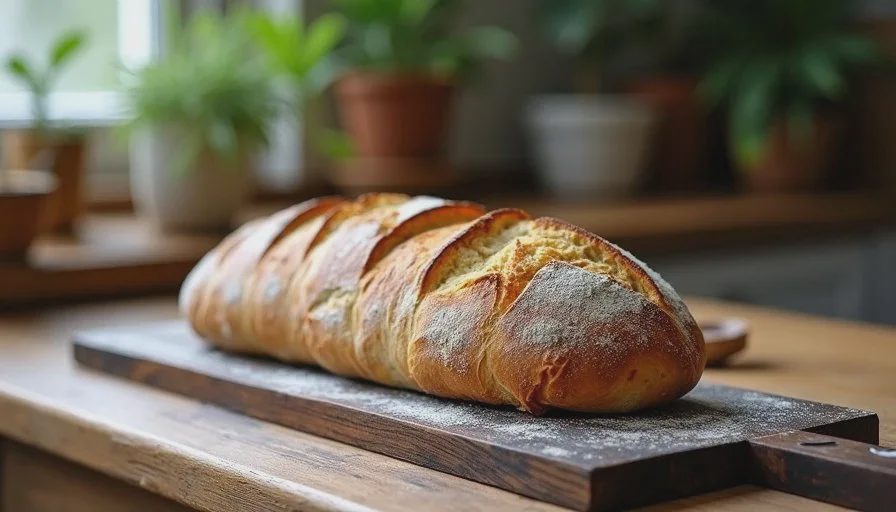
A one-loaf sourdough is often the most practical way for a small household to enjoy naturally leavened bread without managing excess. Full-size formulas frequently yield two or more loaves, which can mean freezing, giving away, or watching the second loaf pass its best window. Scaling the process to a single loaf keeps the fermentation manageable, the baking time reasonable, and the finished bread sized for the people who will actually eat it.
I began adjusting sourdough formulas downward after moving from bakery production into a regular home kitchen. In a professional setting large batches made sense. At home, with a family of three and limited counter space, a single loaf that could be mixed in the evening and baked the next day fit the rhythm of the week far better. The method that follows is built around that experience: hand mixing, ordinary pans or a Dutch oven, and timing that can flex around real schedules rather than demanding a free weekend.
This is not a minimalist challenge or a simplified “beginner” version that sacrifices flavor. It is a complete one-loaf process that produces a crusty exterior and an open, tender crumb when the dough is handled with attention to its actual condition rather than rigid clock times.
Why One Loaf Works Better for Most Homes
Sourdough rewards consistency, yet consistency is easier to maintain when the quantity matches the household’s appetite and the baker’s available time. A single loaf requires less starter, less flour, and less physical space during bulk fermentation and shaping. The dough mass is small enough to mix thoroughly by hand without fatigue and small enough to assess by feel at every stage.
Storage becomes simpler. A freshly baked loaf can be finished over two or three days while it is still excellent. There is no second loaf competing for counter space or freezer space. The baker can bake more frequently if desired, which keeps the starter active and the process familiar.
Timing also flexes more easily. A one-loaf dough can be mixed after dinner, left to bulk ferment overnight in a cool kitchen, shaped in the morning, and baked by midday or early afternoon. Larger doughs often need more precise temperature control and longer blocks of attention. The smaller scale reduces the cost of a timing miscalculation; if the dough moves faster or slower than expected, the adjustment is still manageable.
These practical advantages do not change the fundamental requirements of sourdough: an active starter, adequate gluten development, and sufficient fermentation. They simply align those requirements with the conditions of a typical home kitchen.
Starter Considerations for a Single Loaf
A healthy, active starter is still the foundation. For a one-loaf bake, the amount of starter needed is modest—usually 50 to 100 grams depending on the formula and the desired fermentation speed. Maintaining a small starter jar is therefore sufficient. Feeding a jar that holds 100 to 200 grams of ripe starter keeps waste low while providing enough for regular baking.
The starter should be at its peak when it is mixed into the dough: risen, domed, and smelling pleasantly tangy rather than sharply acidic or inactive. If the starter has been stored in the refrigerator, one or two feedings at room temperature are usually enough to bring it back to full activity. In a cool kitchen the timeline may stretch; in a warm kitchen it may move faster. Observing the starter’s volume and aroma is more reliable than following a fixed number of hours.
Because the dough volume is small, the proportion of starter has a noticeable effect on fermentation speed. A higher percentage of starter shortens bulk fermentation; a lower percentage lengthens it. Most one-loaf formulas fall in the range of 15 to 25 percent starter relative to total flour. Adjusting within that range gives the baker control over the schedule without rewriting the entire recipe.
Mixing and Developing the Dough by Hand
Hand mixing is practical and effective at this scale. A medium mixing bowl, a flexible dough scraper or spatula, and clean hands are sufficient.
Begin by combining the water and starter, then adding the flour and salt. Many bakers prefer to mix the flour and water first and let the mixture rest (autolyse) before adding the starter and salt. Either sequence works. The goal at this stage is simply to bring the ingredients together into a shaggy mass with no dry flour remaining.
After a short rest, begin a series of gentle stretch-and-folds or coil folds. In a small dough these folds are easy to perform directly in the bowl. Each set takes less than a minute. The dough will gradually transform from rough and sticky to smoother and more cohesive. Four to six sets of folds spaced 20 to 30 minutes apart are usually enough for a moderate-hydration one-loaf dough. The exact number depends on the flour and the feel of the dough rather than a fixed count.
The dough is ready to move into bulk fermentation when it feels elastic, holds a shape after folding, and shows some early signs of expansion. It does not need to be perfectly smooth or windowpane-thin at this stage. Over-working a small dough is possible but less common than under-developing it; stopping when the dough has clear strength is the safer approach.
Hydration can be adjusted during mixing. If the dough feels overly stiff, a few extra grams of water can be worked in. If it feels soupy, a small amount of flour can be added. These micro-adjustments are easier and more accurate with a one-loaf quantity.
Bulk Fermentation and Judging Readiness
Bulk fermentation is where most of the flavor and structure develop. For a one-loaf dough the volume increase is easier to see in a small container or bowl marked with a rubber band or piece of tape.
Temperature is the largest variable. In a kitchen around 72–75°F a typical one-loaf dough may need four to six hours to reach readiness. In a cooler kitchen the time stretches; in a warmer one it shortens. The dough is usually ready when it has increased by roughly 30 to 50 percent, feels airy and alive, and shows small bubbles on the surface or sides of the container. A gentle poke leaves a slight indentation that slowly fills back.
Because the dough mass is small, it responds more quickly to temperature changes. Placing the bowl in a slightly warmer or cooler spot gives the baker a useful degree of control over the schedule. An overnight bulk in a cool kitchen is often convenient: mix in the evening, fold a few times, then leave the dough to rise slowly until morning.
The end of bulk fermentation is determined by the dough’s condition, not the clock. A dough that has not expanded enough will produce a denser loaf. A dough that has gone too far may be sticky, weak, and difficult to shape. Learning the visual and tactile signs for the specific flour and starter in use is more valuable than memorizing a standard time.

Shaping, Final Proof, and Baking
Shaping a single loaf is straightforward. Turn the dough out onto a lightly floured surface, pre-shape it into a loose round, and let it rest for 15 to 20 minutes. Then shape it into a tight boule or batard, creating surface tension without tearing the dough. The small size makes it easy to feel whether the tension is adequate.
Place the shaped loaf in a floured banneton or a towel-lined bowl. The final proof can be done at room temperature for one to three hours, or in the refrigerator overnight for added flexibility and flavor. A cold proof is often the most practical option for home bakers: the loaf can be shaped in the evening or morning and baked when the schedule allows.
The loaf is ready to bake when it has expanded modestly and a gentle poke leaves an indentation that fills back slowly. An under-proofed loaf will burst or open irregularly in the oven. An over-proofed loaf may flatten and produce a denser crumb.
Baking can be done in a Dutch oven or on a baking stone or steel with steam. A Dutch oven is convenient for a single loaf because it traps steam effectively and requires no additional equipment. Preheat the vessel thoroughly. Score the loaf, transfer it carefully, cover, and bake. After the covered phase, remove the lid to finish browning and crisping the crust. Exact times vary with oven and loaf size, but a typical one-loaf bake falls in the range of 35 to 45 minutes total.
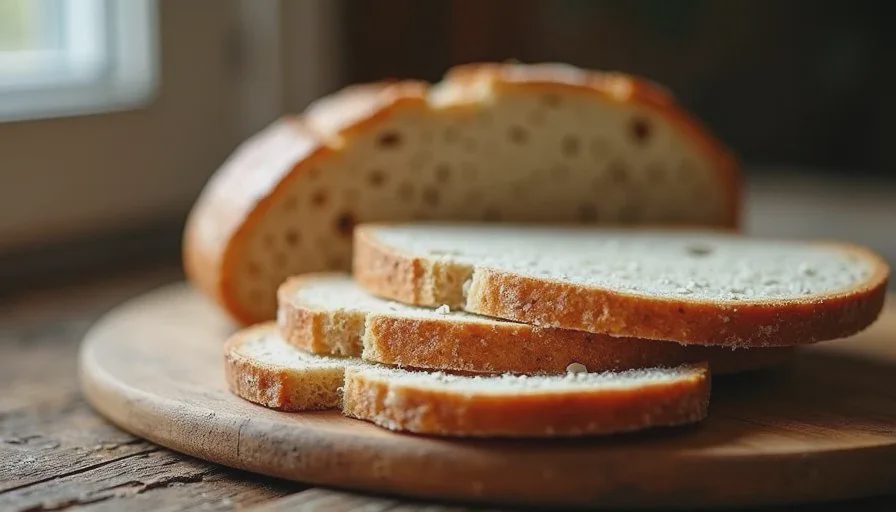
The loaf is done when the crust is deeply colored and the internal temperature reaches approximately 205–210°F. Cooling on a rack for at least an hour allows the crumb to set. Slicing too early produces a gummy texture even if the bake was complete.
Common Adjustments and What to Watch
Several ordinary variables affect the one-loaf process.
Flour choice changes hydration needs and fermentation speed. A higher-protein flour may require slightly more water and produce a chewier crumb. A lower-protein all-purpose flour may need less water and ferment a bit faster. Notes about the specific flour used help future bakes stay consistent.
Starter strength influences timing more noticeably in a small dough. A very active starter shortens bulk fermentation; a milder one lengthens it. Adjusting the percentage of starter or the temperature of the bulk gives practical control.
Kitchen temperature is rarely constant. Seasonal changes, heating, and cooling systems all affect the dough. Observing the dough rather than the clock remains the most reliable guide.
Oven behavior varies. An oven that runs hot can over-brown the crust before the interior is fully baked. One that runs cool may need additional time. An oven thermometer and attention to crust color and internal temperature produce more consistent results than relying solely on the recipe’s suggested minutes.
These adjustments are incremental. The one-loaf format makes them low-risk; a single imperfect loaf still provides clear information for the next attempt without producing a large quantity of bread that must be managed.
Fitting the Process into Ordinary Days
The real advantage of a one-loaf sourdough is that it can be adapted to the rhythm of a regular week. An evening mix followed by an overnight bulk and a morning shape works for many households. A daytime bulk with an evening bake is equally possible. A long cold proof allows the baker to pause the process and resume when time allows.
The active work is limited: mixing and folding take a modest amount of attention spread over an hour or two; shaping takes a few minutes; baking requires presence mainly for loading and unloading the oven. The rest of the time the dough is simply fermenting.
This distribution of effort makes sourdough sustainable for people who cannot devote an entire day to bread. The loaf that results is still fully fermented, properly developed, and sized for the household that will eat it. The process remains connected to the rest of ordinary life rather than competing with it.
A single well-made loaf that is finished while it is still at its best is more useful than a larger quantity that lingers past its peak. That is the practical argument for baking sourdough at the scale of one loaf.
Small batch, real life, something worth sharing.



No notes yet — write the first one.